Anxiety Is a Signal, Not an Identity
Dec 19, 2025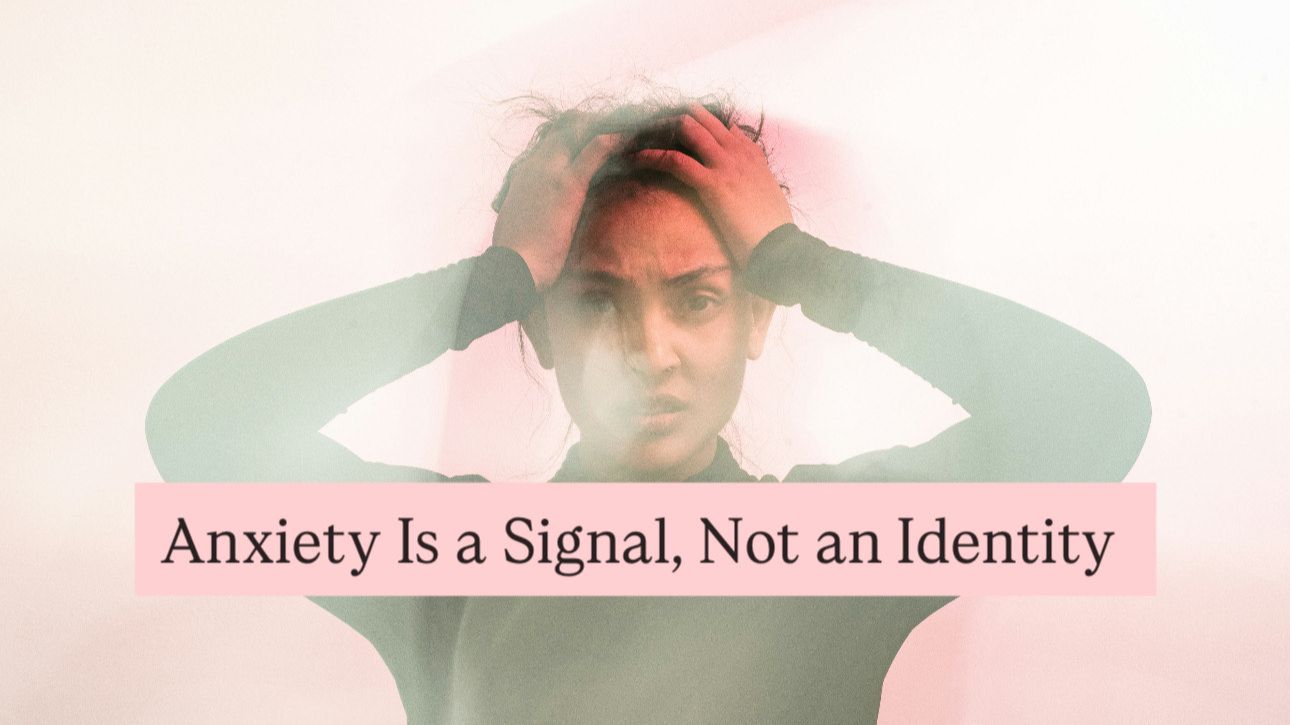
If you’ve ever said, “I’m just an anxious person,” I want to invite you into a completely different way of understanding yourself. Because anxiety isn’t who you are — and it was never meant to be your identity.
Anxiety is a signal.
A message.
A form of communication from your body and brain.
And when you learn how to listen to it — instead of internalizing it — everything changes. You stop feeling like you’re broken. You stop spiraling into shame. And you start responding with clarity and compassion.
Today, I want to take you deeper into what anxiety really is, why so many women feel like it defines them, and how you can start interpreting the signals your body is sending you.
Anxiety Is Communication, Not Character
Somewhere along the way, many of us absorbed the identity of “being anxious.” Maybe it was modeled in childhood. Maybe it came from a stressful season you never fully recovered from. Maybe it’s because society slaps labels on everything.
But anxiety isn’t an identity — it’s a response.
Your body is wired to protect you.
Your nervous system is designed to get your attention when something is off.
Your anxiety is simply your internal system saying, “Hey, something needs care.”
It’s the check-engine light on your dashboard.
It’s not the whole car.
What Anxiety Actually Is (Biologically)
Anxiety feels emotional, but its roots are biological.
Here’s what’s happening under the surface:
- Your amygdala detects a threat — real or perceived.
- Adrenaline and cortisol rise.
- Your heart rate increases.
- Your breathing shifts.
- Digestion slows.
- Your body prepares to protect you.
This happens in milliseconds — long before your thinking brain catches up.
And because the nervous system doesn’t distinguish between physical danger and emotional discomfort, the “anxiety signal” can be triggered by:
- low blood sugar
- lack of sleep
- too much caffeine
- inflammation
- a difficult conversation you’re avoiding
- overstimulation
- or even a negative thought loop
The key takeaway: your body is signaling something. The question is what?
The Metabolic Roots of Anxiety
Let’s talk physiology — because it matters more than people realize.
A huge percentage of anxiety symptoms stem from metabolic imbalance:
Blood sugar instability:
Small glucose crashes release adrenaline — which can feel exactly like anxiety.
Under-eating protein:
Your brain can’t make stable neurotransmitters without it.
Poor sleep:
A sleep-deprived brain is up to 60% more reactive the next day.
Caffeine without food:
This is a recipe for jittery, anxious physiology.
Inflammation:
Inflamed bodies create inflamed minds.
So many women are walking around thinking they have a psychological problem when they actually have a physiological one. When you support your metabolic health, your emotional stability often improves dramatically.
Stop Calling Yourself “An Anxious Person”
There’s a massive difference between saying:
“I feel anxious today,”
and
“I am an anxious person.”
One describes an experience.
The other creates an identity.
And identity shapes behavior.
The more you tell yourself you are anxious, the more your brain will look for evidence to support it. This is why language matters. Your words teach your brain what to expect.
You’re not an anxious person.
You’re a person who experiences anxiety — just like every other human on earth.
And those experiences are signals, not character traits.
What Anxiety Might Really Be Signaling
If anxiety is a messenger, what’s the message?
Sometimes the signal is emotional:
- You’re overwhelmed.
- You’re sacrificing your needs.
- You’re abandoning your boundaries.
- You’re operating out of alignment with your values.
Other times the signal is physical:
- You need to eat.
- You need sleep.
- You need protein.
- You need movement.
- You need a break.
And sometimes, the signal is relational:
- This dynamic isn’t healthy.
- You’re carrying responsibilities that aren’t yours.
- You’re shrinking yourself to keep the peace.
- You’re craving connection but pretending you’re fine.
Anxiety often shows up when something isn’t aligned — in your body, your habits, your relationships, or your beliefs.
We’re Living in an Anxious Culture
We can’t ignore the environment we’re all operating in.
Most of us are:
- overstimulated
- under-rested
- over-caffeinated
- undernourished
- more connected digitally than physically
Our phones rarely stop buzzing.
Our schedules barely allow us to breathe.
We don’t transition well between tasks.
We don’t sit in silence.
We don’t slow down.
The culture is anxious — but you don’t have to be.
You can build a lifestyle that supports your nervous system instead of overwhelming it.
The “False Alarm” Issue
Sometimes anxiety isn’t signaling anything present — it’s signaling something past.
Your nervous system might still be reacting to old patterns, old traumas, old environments, or old beliefs.
This creates “false alarms,” where the body says, “Danger!” even when life is calm and safe.
This is where lifestyle tools make a huge difference:
- walking
- strength training
- cold exposure
- structured routines
- journaling
- fasting (when done intentionally)
- boundary work
- therapy
- genuine community
These help retrain your nervous system to recognize safety again.
Anxiety and Avoidance
Here’s a truth we don’t talk about enough:
Anxiety often shows up when you’re avoiding something.
Avoiding a conversation.
Avoiding a decision.
Avoiding a truth.
Avoiding your own needs.
The more you avoid it, the louder your anxiety gets — because the signal is trying to surface what you’re pushing down.
When you finally face the thing?
The anxiety softens.
Almost instantly.
Avoidance is like trying to hold a beach ball underwater. Eventually, it pops up — and usually at the worst possible time.
Facing the truth is the release valve.
What Actually Helps Anxiety Long-Term
Let’s get practical — because this is where healing takes shape.
Here’s what truly supports a calmer baseline:
- consistent blood sugar
- sufficient protein
- good sleep
- strength training
- daily walking
- cold exposure
- structured routines
- meaningful connection
- boundaries
- honest self-reflection
- a lifestyle that supports your nervous system
- an identity that aligns with calm, grounded living
Anxiety calms when your body feels safe and your mind feels supported.
You Are Not Your Anxiety
If you take one thing from this, let it be this:
You are not an anxious person.
You are a person with a body that communicates.
A body that wants your attention.
A body that is doing everything it can to keep you safe.
Anxiety is your signal — not your identity.
And as you learn to decode those signals, you become more grounded, more clear, and more confident in who you truly are.
Join Lifestyle School for Weight-Loss, the step-by-step program designed to help you lose weight, feel confident in your body, and simplify healthy living. Learn how to use fasting, nutrition, and sustainable habits to create lasting results—all without the overwhelm.
Let’s do this together! 💪
Ready to Start Fasting the Right Way?
Get my "4 Steps to Getting Started Fasting the Right Way" guide for free! This quick, easy-to-follow resource will help you ease into fasting, avoid common mistakes, and feel confident on your journey to better health. Sign up now and start fasting with confidence! ✨
We hate SPAM. We will never sell your information, for any reason.
